



The History of Free Flight

Written by Lindsay Sprague Online Exclusive Content.
Free Flight is the oldest form of aeromodeling competition. The first national competition was held in 1915, sponsored by the Aero Club of America. It was open to clubs only, unlike today. There were three events: distance, duration launching from water, and duration launching from ground. The competition was divided into three events, one per month beginning in August. Cash prizes were awarded to the best scores for each month. After the three events were complete, a trophy was awarded to the club whose members had the highest collective scores.
Illinois Model Aero Club (IMAC) won in three consecutive meets: 1915, 1916, and 1919 (no competitions were held in 1917 and 1918 because of World War I.) If the same club won three years in a row, it was permanently awarded the trophy.
Aeromodeling events declined during the next few years. IMAC tried to hold a national aeromodeling event in 1922, but failed. The club tried again in 1923 and Charles Dickinson stepped in to help. He provided his converted World War I Breguet bomber to fly a committee to meet with race organizers. This led to a successful national competition held in St. Louis that year. This was the first year that winners were not restricted to clubs; individuals could win. Bernard Mulvihill, vice president of the National Aeronautic Association (NAA) provided $300 and the Mulvihill Trophy to the winners.

The Miss Philadelphia II at the National Model Aviation Museum
Two models stand out as game-changers for Free Flight competition during the 1930s: the Miss Philadelphia II and the Zipper prototype. Maxwell Bassett designed the Miss Philadelphia II in 1932. In the 1933 Nats, Max Bassett, Bill Brown, Charlie Grant, and Joe Kovel entered the first engine-powered model. It was allowed to compete in the rubber event because rules had not yet been put in place to prevent it. They had overwhelming success, sweeping all three divisions, which led to a rules change for 1934. The new rule created a gasoline engine division.

The Zipper at the National Model Aviation Museum
The Zipper prototype was the first Pylon racer model. Carl Goldberg designed the Zipper in 1938. During this time, gas models were only allowed a certain amount of fuel based on the model’s total weight, resulting in large, slow-flying aircraft. The airplanes would stay in the air for a long time, causing judges to chase the models by car, sometimes for hours.
In 1937, a rules change limited models to a 4½ foot wingspan and a 30 second engine run. Goldberg constructed a new aircraft. His first design, the Zipper, had a larger engine, allowing for a faster climb and longer duration. It was hand-launched vertically, instead of off the ground. This changed the design of Free Flight aircraft.
Free Flight, which continues to be a popular modeling category, has a rich history that has helped pave the path to where we are today. Visit the National Model Aviation Museum, located at AMA Headquarters in Muncie, Indiana, to learn more about the history of Free Flight.
Similar Articles
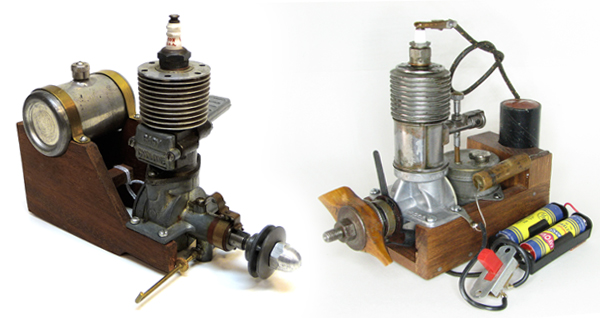 |
History of Model Engines Written and designed by Bill Mohrbacher Read more on page 28 in the February 2012 issue. |
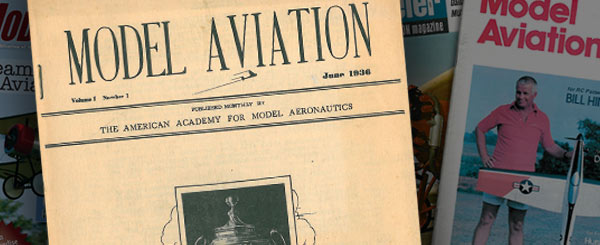 |
History of Model Aviation Written by Jay Smith & Michael Smith Read more on page 28 in The First 75 Years supplement |
 |
RC Helicopters Debut at 1978 Nats Written by Dave Chesney Model Aviation Library, November 1978 |


This Month's Issue
Join the AMA


1 comments
Zipper description.
Add new comment